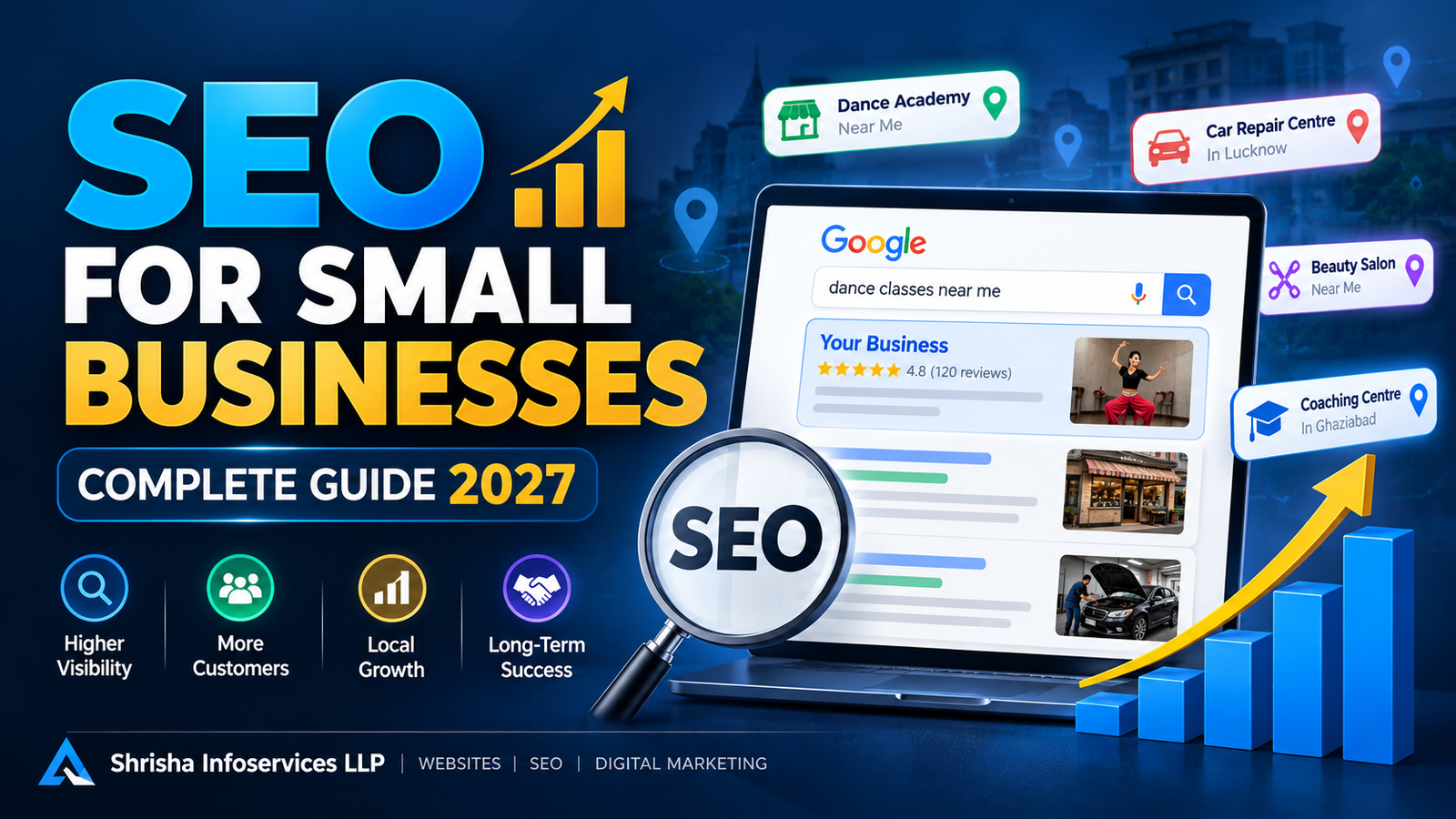
Imagine you own a dance academy in Ghaziabad. Someone nearby searches Google for “dance classes near me,” but your academy doesn’t appear in the results.
Instead, potential customers discover your competitors.
This is where Search Engine Optimization (SEO) becomes important.
For small businesses in India, having a professional website is an important first step. But a website alone does not guarantee that customers will discover your business.
SEO helps improve your website’s visibility in relevant search results, making it easier for potential customers to find your products or services.
In this guide, we’ll explain what SEO is, how it works, why it matters for small businesses, and how you can start improving your online visibility in 2027.
Table of Contents
1. What Is SEO?
SEO stands for Search Engine Optimization.
It is the process of improving your website and online presence so search engines such as Google can better understand your content and consider it for relevant search results.
For example, imagine someone searches for:
- Best dance academy in Ghaziabad
- Car repair centre in Lucknow
- CA services for small businesses
- Website designer for small business
- Beauty salon near me
Businesses with relevant, helpful, technically accessible websites and strong local information may have better opportunities to appear in these searches.
SEO is not simply about adding keywords to a website. It also involves content quality, website structure, technical performance, user experience, and business credibility.
The objective of SEO is to attract relevant visitors who are genuinely interested in what your business offers.
2. How Does Google Search Work?
To understand SEO, it helps to know how Google discovers and displays websites.
Google Search generally involves three important processes.
Crawling
Google uses automated programs called crawlers to discover publicly accessible webpages.
These crawlers follow links and identify new or updated content.
Indexing
Google analyzes discovered webpages and may store information about them in its search index.
Not every discovered webpage is necessarily indexed.
Ranking and Serving Results
When someone searches for information, Google evaluates relevant indexed pages and other search features to determine which results may best answer the query.
Search results can depend on factors such as relevance, content quality, location, and the nature of the search.
SEO helps make your website easier to discover, understand, and use.
However, SEO does not guarantee indexing or a particular ranking position.
3. Why Is SEO Important for Small Businesses?
SEO can provide several business advantages.
Helps Customers Discover Your Business
Potential customers frequently search online before contacting a business.
For example, a parent looking for Taekwondo classes may search for academies in their city.
If your academy has relevant website content and an optimized local business presence, it may be easier for that parent to discover you.
Attracts Relevant Website Visitors
SEO focuses on searches related to your products, services, or customer questions.
A visitor searching for “website development company for small business” may already be researching a service they need.
This makes relevant search traffic valuable, although visits do not automatically translate into enquiries or sales.
Builds Business Credibility
A professional website with useful information, clear contact details, authentic testimonials, and a strong online presence can help potential customers evaluate your business.
SEO supports discoverability, while the quality of your website and business reputation helps build trust.
Supports Long-Term Visibility
Unlike advertising campaigns that generally stop delivering paid traffic when spending ends, useful website content can continue attracting organic visitors over time.
However, search rankings are not permanent. Competition, search algorithms, content quality, and changing customer behaviour can influence performance.
Helps You Compete Locally
A small business does not necessarily need a large national marketing budget to compete for every relevant local search.
A well-maintained local business profile, useful service pages, accurate contact information, and customer reviews can help improve local discoverability.
4. Local SEO vs Traditional SEO
SEO strategies differ depending on the customers a business wants to reach.
Local SEO
Local SEO focuses on improving visibility for searches connected to a particular geographical area.
Examples include:
- Dance classes in Ghaziabad
- Car mechanic in Lucknow
- Coaching centre near me
- Tax consultant in Noida
Local SEO is particularly useful for businesses serving customers in a defined location.
Broader Organic SEO
Broader organic SEO targets relevant searches that may not depend on the searcher’s immediate location.
For example:
- How much does a business website cost in India?
- How to choose an e-commerce platform
- Benefits of SEO for small businesses
An online business serving customers across India may benefit from this broader approach.
Many small businesses need a combination of local SEO and broader organic SEO.
5. Google Business Profile and Local Visibility
For businesses serving customers face-to-face or within a defined service area, a Google Business Profile can be an important part of local SEO.
A properly maintained profile may display business information across Google Search and Maps.
Useful information includes:
- Correct business name
- Appropriate business category
- Accurate address or service area
- Phone number and website
- Business hours
- Relevant photographs
- Services offered
- Genuine customer reviews
For example, a car repair centre in Lucknow can use its Business Profile to help nearby customers find its location, contact details, and operating hours.
Business owners should also respond professionally to reviews and keep their information updated.
Creating or optimizing a Business Profile does not guarantee a top position in Google Maps.
6. Three Main Types of SEO
SEO activities are commonly grouped into three categories.
On-Page SEO
On-page SEO focuses on improving individual webpages.
Examples include:
- Writing useful, original content
- Using clear page titles and headings
- Including relevant keywords naturally
- Creating descriptive URLs
- Adding relevant internal links
- Writing helpful image alternative text
- Matching content to search intent
For example, a dance academy could create separate pages for Kathak classes, contemporary dance, and children’s dance programs if those are genuine services it offers.
Each page should provide useful information rather than repeat the same content with different keywords.
Technical SEO
Technical SEO helps search engines access and understand your website.
Important considerations include:
- Mobile-friendly design
- Fast and stable page loading
- HTTPS security
- Crawlable website navigation
- Appropriate indexing settings
- XML sitemaps
- Canonical URLs
- Structured data where relevant
- Fixing broken links and technical errors
A visually attractive website can still experience search visibility problems if important pages are blocked from indexing or difficult to crawl.
Off-Page SEO
Off-page SEO involves signals and activities outside your own website.
Examples include relevant editorial backlinks, business mentions, and maintaining accurate information on appropriate external platforms.
A backlink is a link from another website to yours.
Useful, relevant links may help search engines discover your content and assess its context.
Avoid purchasing manipulative links or participating in link schemes intended to artificially influence rankings.
7. SEO vs Google Ads: What’s the Difference?
SEO and Google Ads can both help businesses attract potential customers, but they work differently.
| Factor | SEO | Google Ads |
|---|---|---|
| Visibility | Organic search results | Paid advertising placements |
| Traffic cost | No charge per organic click | Advertising charges may apply |
| Initial results | Often takes time | Can generate visibility soon after campaign approval |
| Ongoing investment | Content, optimization, maintenance | Advertising budget and campaign management |
| Long-term potential | Can support sustained visibility | Paid traffic generally depends on continued spending |
| Guaranteed results | No | No |
SEO is often useful for developing long-term organic visibility.
Google Ads can help businesses reach potential customers more quickly when campaigns are properly configured and funded.
For example, a new coaching centre might use Google Ads to promote admissions while simultaneously developing its website’s organic visibility through SEO.
The best approach depends on your business objectives, budget, competition, and timeline.
8. How Long Does SEO Take to Show Results?
SEO is generally a gradual process.
Some technical improvements may be discovered relatively quickly, while competitive searches can require sustained work over several months or longer.
The timeline depends on:
- Website age and existing visibility
- Competition
- Quality and relevance of content
- Technical condition of the website
- Geographic target market
- Search demand
- Consistency of optimization
A new website competing for a broad keyword such as “best website development company in India” may face considerably more competition than a specialized local service page.
Instead of expecting guaranteed rankings within a fixed period, businesses should track meaningful progress through search visibility, relevant visits, enquiries, and conversions.
9. Common SEO Mistakes Small Businesses Make
Many businesses invest in a website but overlook important SEO fundamentals.
Publishing a Website Without Search Optimization
A website needs clear content, accessible navigation, relevant page titles, and appropriate indexing settings.
Simply launching a website does not guarantee search visibility.
Targeting Only Highly Competitive Keywords
Small businesses may struggle to compete immediately for broad national keywords.
More specific searches related to genuine services and customer needs may provide a practical starting point.
Ignoring Mobile Users
Potential customers frequently browse websites on mobile devices.
A website that is difficult to read, navigate, or use on mobile can create a poor customer experience.
Keyword Stuffing
Repeating the same keyword unnaturally does not make content more useful.
Write for people first, using search terms naturally where relevant.
Neglecting Google Business Profile
Eligible local businesses may miss useful discovery opportunities when their profiles contain outdated or incomplete information.
Expecting Immediate Results
SEO requires monitoring, ongoing improvements, and realistic expectations.
Avoid providers promising guaranteed first-page rankings or instant organic traffic.
10. How Much Does SEO Cost in India?
SEO pricing in India varies depending on the work required.
Factors influencing cost include:
- Number of pages and services
- Local or national targeting
- Industry competition
- Website’s current technical condition
- Content requirements
- Number of locations
- Reporting and optimization scope
For planning purposes, businesses may encounter indicative monthly service budgets such as:
| SEO Service Scope | Illustrative Monthly Budget |
|---|---|
| Basic local SEO | ₹5,000–₹12,000 |
| Small business SEO | ₹10,000–₹25,000 |
| Broader or competitive SEO | ₹25,000–₹60,000+ |
These figures are illustrative budgeting ranges, not verified market averages or fixed Shrisha Infoservices pricing. Actual quotations may fall outside these ranges.
If you’re also planning to build a new website, read our guide to website development cost in India to understand the overall investment.
SEO costs should be evaluated alongside the deliverables, reporting quality, business objectives, and expected ongoing work.
11. How to Get Started With SEO for Your Small Business
You do not need to implement every SEO technique immediately.
Start with a practical foundation.
Step 1: Identify your ideal customers. Understand what they need and what they might search for online.
Step 2: Build a professional website. Ensure it clearly describes your services and provides convenient ways to contact your business.
Not sure whether your business needs its own website? Read our article on why small businesses need a website
Step 3: Research relevant keywords. Focus on genuine customer questions and service-related searches.
Step 4: Optimize important pages. Write descriptive titles, headings, and useful service content.
Step 5: Set up Google Search Console. Use it to monitor search performance and identify indexing issues.
Step 6: Improve technical performance. Check mobile usability, loading experience, internal navigation, and important technical settings.
Step 7: Optimize local visibility. If eligible, create or improve your Google Business Profile.
Step 8: Publish helpful content. Answer common customer questions through informative pages and articles.
Step 9: Measure results. Track relevant search traffic, enquiries, and conversions rather than rankings alone.
Step 10: Improve consistently. Review performance and update your website as your business evolves.
12. Frequently Asked Questions About SEO
Not every business requires the same SEO investment. However, businesses whose customers use search engines to find services, products, or local providers may benefit from improving their search visibility.
Yes. Small business owners can handle many foundational activities, such as improving website content, maintaining business information, and learning to use Google Search Console. More complex technical or competitive projects may benefit from professional assistance.
Google does not charge websites for appearing in organic search results. However, SEO work may involve costs for content creation, technical improvements, professional services, and software tools.
No. Search engines determine rankings using their own systems, and no SEO provider can guarantee a particular organic position.
An eligible business can maintain a Google Business Profile without having a website. However, a professional website provides additional space to explain services, publish helpful information, and convert interested visitors into enquiries.
Neither is universally better. SEO can support long-term organic visibility, while Google Ads offers paid advertising opportunities. Many businesses benefit from combining both according to their goals and budgets.
SEO should be reviewed regularly, particularly when services, website content, competition, search performance, or technical conditions change. The appropriate frequency depends on the business and its website.
13. Conclusion: SEO Is an Investment in Business Discoverability
SEO is not simply about appearing at the top of Google.
It is about helping potential customers discover relevant information about your business when they are actively searching for products, services, or solutions.
For Indian small businesses, a strong SEO foundation can improve online discoverability, support credibility, and create opportunities for qualified enquiries over time.
Whether you operate a dance academy, coaching centre, beauty salon, car repair centre, professional consultancy, or online store, your digital presence should make it easy for customers to find and understand your business.
At Shrisha Infoservices LLP, we help businesses establish and improve their online presence through professional website development, SEO, Google Ads, and other digital marketing services.
If you want to improve your website’s search visibility or develop a stronger digital strategy, contact Shrisha Infoservices LLP to discuss your business requirements.