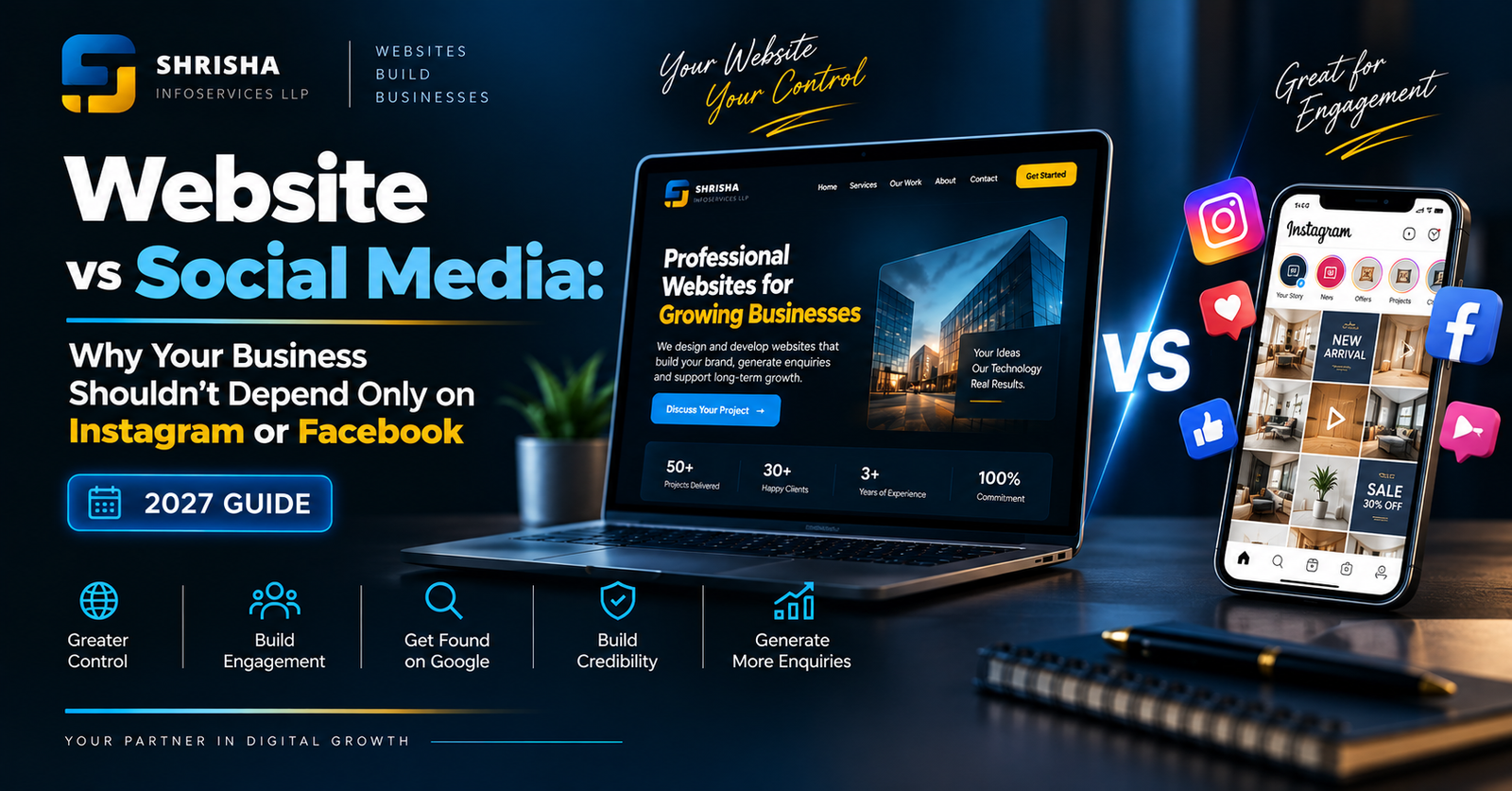
Website vs social media for business: understand the differences and learn why using a website with Instagram and Facebook can build a stronger online presence.
Table of Contents
Website vs Social Media for Business: Which Do You Need in 2027?
Instagram, Facebook and other social platforms have made it easier than ever for small businesses to establish an online presence.
You can publish photos, showcase products, communicate with customers and promote your services without building a website.
So an obvious question arises:
If your business is already active on social media, do you really need a website?
Also Read: Does Your Small Business Really Need a Website in 2027?
For many businesses, the better question is not website or social media?
It is:
How should your website and social media work together?
Social media can be excellent for reaching and engaging people, while a website gives your business a more structured and controlled online presence.
Understanding the difference can help you build a stronger digital strategy.
Website vs Social Media: What’s the Main Difference?
A business website and a social media account serve different purposes.
Your website is a digital property built around your business. You control its structure, pages, branding, content and customer journey.
Your social media presence operates within someone else’s platform. You can customize your profile and content, but you still work within that platform’s features, policies and algorithms.
A simple way to understand the difference is:
| Business Website | Social Media |
| Greater control over presentation | Platform controls the environment |
| Detailed service information | Best suited to shorter, frequent content |
| Can support search visibility | Strong for discovery and engagement |
| Custom enquiry journey | Platform-defined interactions |
| Content can remain organized long term | Posts can quickly move down the feed |
| Uses your own domain | Uses the platform’s domain/account |
| Designed around your business | Designed around the social network |
This doesn’t make one inherently better than the other. They solve different problems.
1. Your Website Gives You More Control
Suppose your business relies entirely on Instagram.
Your followers, posts and messages all exist within Instagram’s ecosystem.
If the platform changes how content is distributed, modifies a feature, restricts an account or changes its policies, your business has limited control over that decision.
With your own website, you have much greater control over:
- Your branding
- Page layouts
- Service information
- Calls to action
- Contact forms
- Portfolio
- Blog content
- Customer journey
That control is one of the strongest reasons to establish a website even when social media is performing well for your business.
2. Social Media Is Excellent for Building Engagement
This is where social platforms have a major role.
Instagram and Facebook can help businesses regularly communicate with their audiences.
You can publish:
- Photos
- Videos
- Reels
- Offers
- Customer stories
- Behind-the-scenes content
- New product announcements
- Business updates
This type of content can keep your business visible and encourage interaction.
Your website does not need to replace this activity.
Instead, social media can introduce people to your business and your website can provide the detailed information they need afterward.
For example:
Instagram Reel → Website → Service Page → Enquiry
3. A Website Can Present Your Services More Clearly
Imagine a customer visits your Instagram profile because they are interested in one particular service.
They may have to scroll through dozens of posts to find relevant information.
A website allows you to organize information logically.
For example:
Home → Services → Website Development → Portfolio → Contact
Each service can have its own section or page explaining:
- What you provide
- Who the service is suitable for
- How it can help
- Relevant examples
- Frequently asked questions
- How to contact you
This structured experience can make it easier for a prospective customer to understand your offering.
4. A Website Can Support Google Search Visibility
Social media and search engines provide different methods of discovery.
Someone browsing Instagram might discover a business through a Reel or recommendation.
Someone using Google may already be actively searching for a service.
For example:
“dance classes near me”
“interior designer in Ghaziabad”
“website development company for small business”
“beauty parlour in Ghaziabad”
A properly structured website gives your business pages and content that can potentially appear for relevant searches.
However, simply having a website does not guarantee Google rankings.
Search visibility depends on many factors, including relevance, competition, content quality, technical SEO, authority and local signals.
A website gives you the foundation on which SEO can be developed.
5. A Website Can Strengthen Business Credibility
Imagine discovering two businesses offering similar services.
The first has only an Instagram profile.
The second has an Instagram profile plus a professional website containing its services, company information, previous work and contact details.
Some customers may feel more comfortable researching the second business because more structured information is available.
A website can provide credibility signals such as:
- Company information
- Business address
- Professional contact details
- Portfolio
- Testimonials
- Case studies
- Service information
- Privacy information
- Frequently asked questions
A website by itself does not prove that a company is trustworthy, but it can help customers evaluate a business more thoroughly.
6. Social Media Posts Have a Shorter Visibility Cycle
Social media feeds move quickly.
A post that receives significant attention today may become difficult for customers to find several weeks later.
Important website content works differently.
A well-organized page about one of your core services remains available at the same URL until you decide to change it.
Blog articles can also continue answering customer questions long after publication.
For example, an article explaining:
“How Much Does a Website Cost in India?”
Also Read: Website Development Cost in India (2027): Complete Pricing Guide
can remain useful to people researching website development months after it was published.
This makes websites particularly useful for building a long-term library of business information.
7. Your Website Can Be Designed Around Conversions
Social networks determine much of the interface customers use.
A website gives you more freedom to design the journey.
Suppose the primary goal of your website is generating enquiries.
You might create a journey such as:
Visitor lands on website
↓
Understands the service
↓
Views previous projects
↓
Reads FAQs
↓
Clicks “Discuss Your Project”
↓
Submits enquiry
For another business, the goal might be:
Google Search → Product → Add to Cart → Payment
Or:
Instagram → Landing Page → Book Trial Class
The website can therefore be structured around the action that matters most to the business.
8. Your Website Can Connect Multiple Marketing Channels
One of the biggest mistakes is treating every digital channel separately.
Consider this ecosystem:
Google Search → Website
Instagram → Website
Facebook → Website
Google Ads → Landing Page
WhatsApp → Website
Your website becomes the central destination where customers can learn more and take action.
Social media remains an important channel for attracting and engaging audiences.
The two can support each other rather than compete.
9. What Happens If Your Social Media Account Has a Problem?
Businesses that rely heavily on a single third-party platform face concentration risk.
An account may encounter problems such as:
- Temporary access issues
- Account restrictions
- Hacking
- Policy changes
- Reduced organic reach
- Feature changes
This does not mean businesses should stop using social media.
It means that relying on only one digital channel creates unnecessary dependency.
Maintaining your own website, domain and other customer channels can make your online presence less dependent on a single platform.
10. A Website Can Support Long-Term Content Marketing
Suppose you own a small interior-design company.
On Instagram, you might publish project photos and short videos.
On your website, you could publish detailed articles such as:
How Much Does Interior Design Cost?
How to Choose an Interior Designer
Modular Kitchen Design Ideas
Things to Consider Before Renovating Your Home
These articles can answer questions potential customers are already researching.
You can then share those articles through your social media accounts.
That creates a useful cycle:
Create useful website content → Share on social media → Attract visitors → Build trust → Generate enquiries
Checkout Our Services for professional website / website development
Website or Social Media: Which Should a Small Business Choose?
For many small businesses, this should not be an either/or decision.
A practical approach is:
Use your website for:
Detailed information, service pages, portfolio, enquiry generation, search visibility, long-term content and your primary online business presence.
Use social media for:
Audience engagement, regular updates, photos, videos, community interaction, promotions and content distribution.
Use WhatsApp for:
Direct conversations, quick enquiries and customer communication.
Use Google Business Profile for:
Local business discovery, location information, reviews and local visibility.
Together, these channels can create a much stronger digital presence than relying on only one of them.
Can a Small Business Start With Social Media First?
Yes.
A newly established business with a very limited budget may reasonably begin with social media and other low-cost channels.
The important point is to understand their limitations.
As the business grows, a website can provide a more permanent and structured foundation for its online presence.
And a small-business website does not necessarily need to be complicated.
A straightforward website might initially contain:
Home → About → Services → Gallery/Portfolio → Contact
Additional functionality can be introduced later when the business actually needs it.
When Should You Consider Building a Website?
A website becomes particularly useful when:
- Customers search online for services like yours
- You repeatedly explain the same services to prospective customers
- You want a professional portfolio
- You want enquiries from Google
- You are running Google Ads
- You need dedicated landing pages
- You want to publish useful long-form content
- You want more control over your online presence
- Your business is expanding
- You want your brand to look more established online
If several of these situations apply to your business, it may be worth considering a professional website.
Frequently Asked Questions
It can be enough for some businesses, particularly when starting out or when most customers come directly through social media. However, a website provides capabilities that Instagram does not fully replace, including greater control over information architecture, dedicated service pages and a customizable enquiry journey.
You do not necessarily need to replace a successful Facebook presence. A website can complement it by providing detailed information, dedicated landing pages, portfolio content and another route through which customers can discover your business.
They serve different purposes. Websites are useful for structured information, search visibility and conversions, while social media is particularly useful for engagement, content distribution and audience building. Many businesses benefit from using both.
For some simple business models, social media may provide enough functionality. For businesses that need detailed service information, search visibility, greater control, content marketing or customized conversion journeys, a website provides capabilities that social profiles generally cannot fully replace.
Not necessarily every business needs every social platform. However, where your target customers actively use social media, it can provide an additional way to reach and engage them and direct interested people to your website.
Final Thoughts
The question isn’t really website vs social media.
For many businesses, the strongest approach is to make them work together.
Social media can help people discover and engage with your business.
Your website can help them understand your business, evaluate your services and take the next step.
Rather than building your entire online presence on Instagram or Facebook, consider creating a digital ecosystem in which your website acts as the central business platform and other marketing channels bring relevant people to it.
At Shrisha Infoservices LLP, we help businesses build professional websites and strengthen their online presence through website development and digital marketing.
Want to build a stronger online presence for your business? Discuss your project with Shrisha → Click here