If you are planning to build a website for your business, one of the first questions you are likely to ask is: How much does website development cost in India?
There is no single price that applies to every website. A simple business website and a full e-commerce website have very different requirements. Design complexity, number of pages, functionality, content, hosting and ongoing maintenance can all affect the final cost.
This guide explains the major factors that determine website development cost and helps you understand what budget you may need for your project.
Table of Contents
Website Development Cost in India: Quick Overview
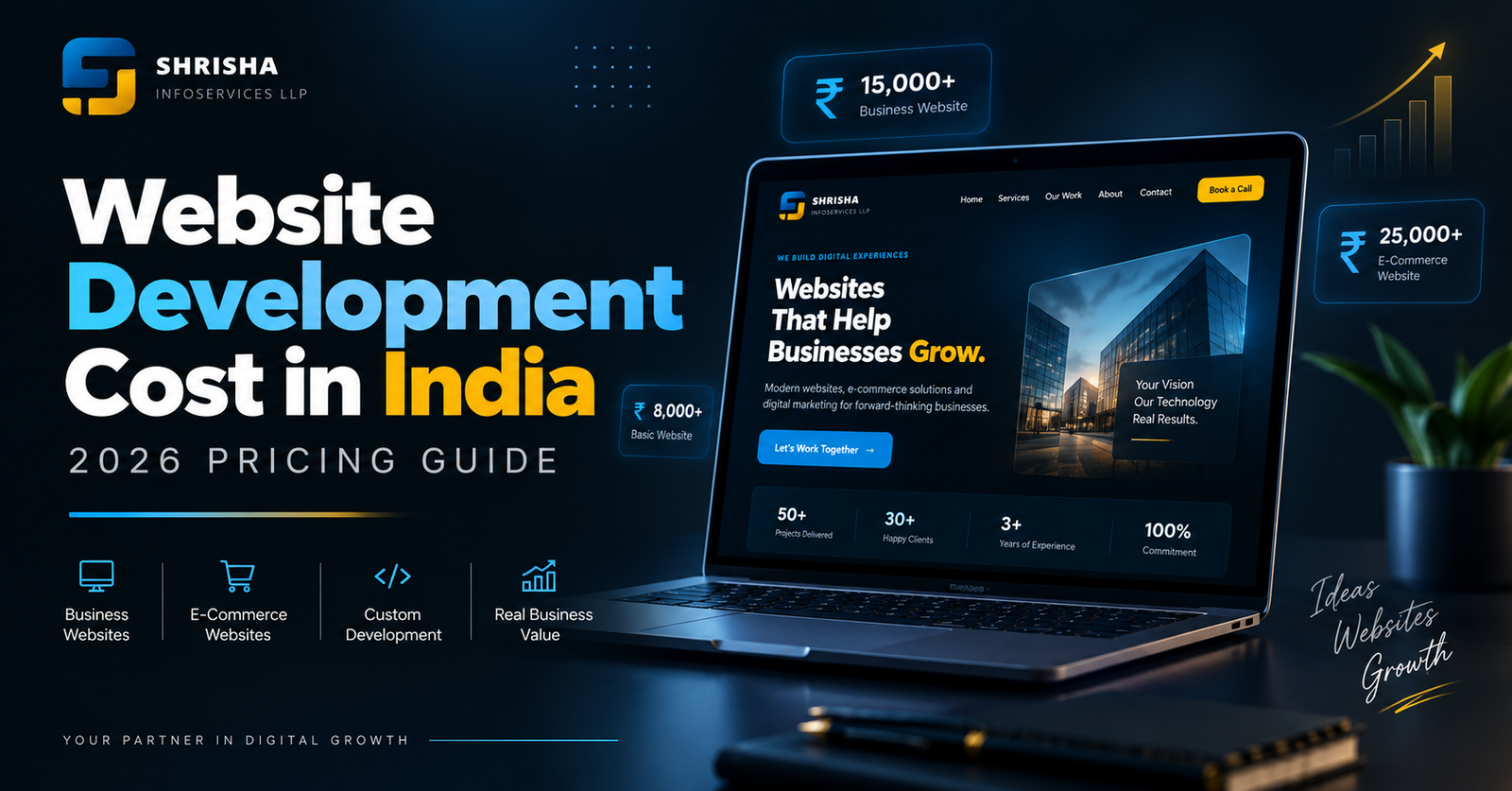
As a broad planning range, website costs in India can look like this:
| Website Type | Indicative Cost |
| Basic informational website | ₹8,000 – ₹20,000 |
| Professional business website | ₹15,000 – ₹50,000+ |
| WordPress website | ₹12,000 – ₹50,000+ |
| E-commerce website | ₹25,000 – ₹1,00,000+ |
| Custom website with advanced functionality | ₹50,000 – ₹2,00,000+ |
These are general indicative ranges, not fixed quotations. The actual price depends on the scope and requirements of the project.
1. Type of Website
The type of website you need has one of the biggest effects on cost.
A small local business may only need a Home, About, Services, Gallery and Contact page. Such a website is considerably simpler than an online store containing hundreds of products, payment processing, customer accounts and order management.
Before requesting quotations, decide what the website actually needs to accomplish for your business.
2. Number of Pages
A five-page business website generally requires less design, content and development work than a website containing 30 or 50 unique pages.
However, page count alone does not determine price. Ten pages based on a common layout may require less work than five pages containing highly customized functionality.
3. Custom Design vs Pre-Built Templates
Template-based websites can reduce development time and cost. They can work well when the requirements are straightforward and the template is properly customized.
Custom design provides greater control over branding, layout and user experience, but normally requires more design and development work.
The right choice depends on your budget, business objectives and how distinctive the website needs to be.
4. Website Features and Functionality
Additional functionality increases development requirements.
Common examples include:
- Contact and enquiry forms
- WhatsApp integration
- Appointment or booking systems
- Online payments
- Product catalogues
- Customer accounts
- Search and filtering
- Maps and location information
- Blog functionality
- Third-party integrations
Rather than adding features simply because they are available, businesses should focus on functionality that helps visitors take useful actions.
Also Check: Websites designed by us
5. E-Commerce Requirements
An e-commerce website usually costs more than a standard business website because it may require product management, shopping cart functionality, payment gateways, shipping configuration, order management and transactional emails.
The number and complexity of products can also affect the amount of work required.
6. Domain and Hosting
The website itself is only part of the overall cost.
You will normally also need a domain name and web hosting. These are usually recurring expenses rather than one-time development costs.
Hosting requirements vary depending on website traffic, storage, performance requirements and the technology being used.
Businesses should therefore consider both the initial development cost and the website’s ongoing operating cost.
7. Mobile Responsiveness
A modern business website should work properly across desktop computers, tablets and smartphones.
Responsive development involves ensuring that layouts, navigation, text, images, forms and buttons remain usable across different screen sizes.
Mobile responsiveness should generally be considered a core website requirement rather than an optional extra.
8. SEO Considerations
Building a website and getting people to discover it are different challenges.
A website should provide a technically sound foundation for search visibility, including logical page structure, mobile usability, appropriate headings, crawlable content and good performance.
Ongoing SEO may involve additional work such as keyword research, content development, local SEO, internal linking and performance monitoring.
Also Check: Our SEO or Digital Marketing Services
9. Website Maintenance
Launching a website is not necessarily the end of the project.
WordPress and similar websites may require software updates, backups, security monitoring, performance checks and occasional content changes.
Businesses should ask whether ongoing maintenance is included in their development package or charged separately.
Cheap Website vs Professional Website: What’s the Difference?
The cheapest quotation is not always the lowest-cost option over the life of a website.
A very inexpensive website may be adequate for a simple requirement, but problems can arise if important areas such as mobile usability, performance, security, maintainability or conversion design are ignored.
At the same time, a business should not pay for complicated functionality it does not need.
A better approach is to choose a solution based on business requirements, quality and long-term value, rather than price alone.
How Much Should a Small Business Budget?
For a small business that needs a professional online presence, the budget should be based on what the website is expected to achieve.
For example, a local service business may need:
Home → Services → About → Portfolio/Gallery → Contact
The priority may be generating calls and enquiries rather than implementing complicated functionality.
An e-commerce business, by comparison, will generally need a larger budget because the website itself becomes part of its sales infrastructure.
Also Read: Does Your Small Business Really Need a Website in 2027?
Questions to Ask Before Getting a Website Quote
Before contacting a website development company, consider:
- What is the main objective of the website?
- Who are your target customers?
- Approximately how many pages do you need?
- Do you need to sell products online?
- Do you need bookings, payments or other special functionality?
- Do you already have your content and images?
- Will you need SEO or digital marketing?
- Who will maintain the website after launch?
Clear answers make it much easier for a developer to provide an appropriate quotation.
Frequently Asked Questions
A basic informational website for a small business may cost roughly ₹8,000–₹20,000, depending on the number of pages, design requirements, content and functionality. More customized business websites can cost significantly more.
An e-commerce website may start around ₹25,000, while larger or more customized stores can cost ₹1,00,000 or more. Product volume, payment integration, shipping rules and custom functionality can significantly affect the final cost.
WordPress can be a practical choice for many business websites because it supports content management, blogging, SEO tools and a large ecosystem of extensions. Whether it is the right platform depends on the project’s requirements.
Usually, yes. Even when website development is a one-time project, domain registration, hosting and potentially maintenance, premium software or other services can involve recurring charges.
A straightforward business website can often be completed within a few weeks, while larger websites can take considerably longer. The schedule depends on design complexity, functionality, content availability, revisions and client approvals.
Final Thoughts
There is no universal answer to how much a website costs in India. A website should be priced according to its scope, design requirements, functionality and the business goals it needs to support.
For a small business, the objective should not simply be to have a website. The website should clearly explain what the business offers, build credibility and make it easy for potential customers to take the next step.
If you’re planning a new website or considering redesigning an existing one, Shrisha InfoServices LLP can help you determine the appropriate approach based on your requirements and budget.
Discuss your project with Shrisha → Contact